Holiday shopping season 2026

Winning top of wallet before the holiday swipe

Want to discuss your holiday season strategy?
Fill out the form below and one of our representatives will schedule an appointment with you.

  • Submit
Holiday Shopping White Paper

Consumers said they’d pull back, but they didn’t.

Here’s what that could mean for your portfolio heading into 2026.

The 2025 holiday season set a record $257.8 billion in online spend,1 despite consumers entering it with the most pessimistic economic outlook since 1997.2 Credit card balances hit $1.28 trillion.3 Buy Now Pay Later (BNPL) crossed $20 billion.1 Holiday shopping also starts earlier each year, and buyer behavior keeps shifting: shoppers now prioritize steep discounts, BNPL and generative AI tools before they commit to a purchase.1 Additionally, Experian data shows income divergence is reshaping who your actual risk is, and early delinquency signals are building faster than aggregate metrics suggest.4 Use this playbook for positioning before October — and stay ahead of the season for “swiping.”

Why the gap between intent and behavior is the key issuer insight

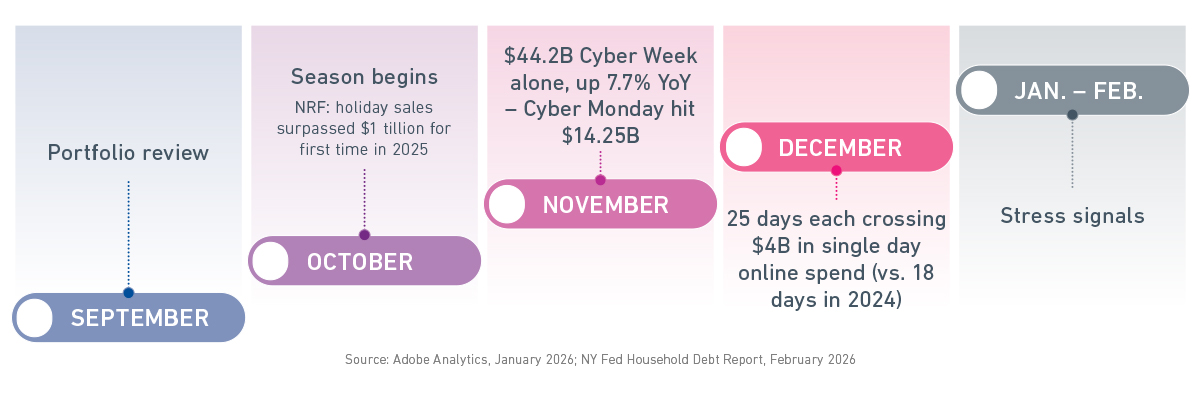
Ahead of the 2025 holiday shopping season, 57% of consumers expected the economy to weaken, the most negative sentiment Deloitte has recorded since 1997.2 However, while planned spend was down 10%,6 actual online spend hit a record,1 credit card balances grew $44 billion in Q4 alone3 and 25 days crossed $4 billion in single-day online sales.1 Consumers spent through uncertainty, and the financial institutions positioned by September captured it.

The compressing window

The holiday season spreads from October through Christmas. Cyber Week sees increased spend, but it captures only a fraction of total season volume, and early delinquency signals are already building in the origination book before peak season even arrives.
1. The stakes

Record spend, rising balances and an income divide

The 2025 season proved consumers will spend through uncertainty. But Experian Q1 2026 data revealed a structural shift beneath the headline numbers: The K-shaped recovery has evolved into an E-shaped divergence, and it’s changing the risk profile of segments that historically looked safe.4

$1.28 trillionCredit card balances at end of Q4 2025 — up $44 billion in the quarter, $66 billion year-over-year NY Fed, February 2026
$20 billionBNPL volume during the 2025 holiday season — a new milestone, up 9.8% year-over-year Adobe Analytics, January 2026
$1+ trillionTotal U.S. holiday retail sales in 2025 — the first season to cross this threshold National Retail Federation

The E-shaped economy — Experian Q1 2026 data

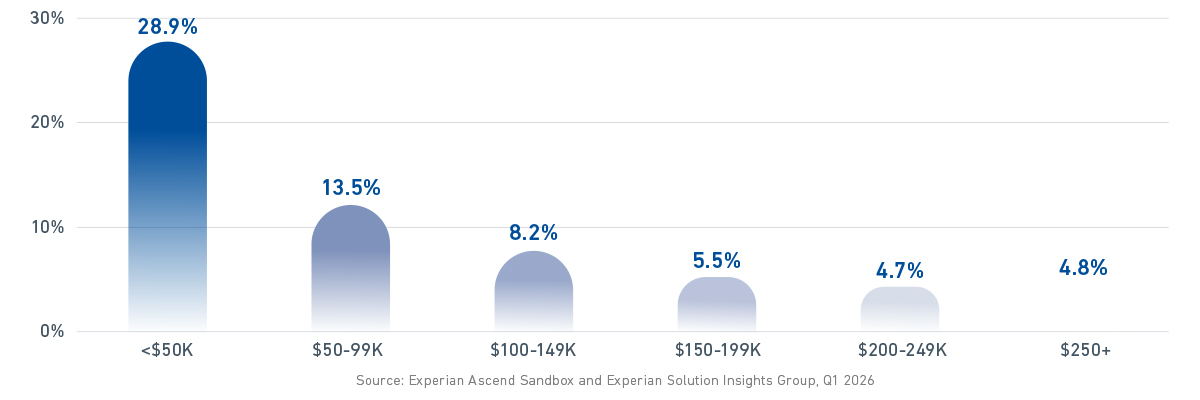
What began as a K-shaped recovery is evolving into a more structural E-shaped divergence, separation widening at both ends while the middle compresses. The population earning over $250K has more than doubled since 2023, but 27% of those high-income consumers have since moved into lower income brackets, linked to job loss and retirement. At the lower end, 85% of those earning under $50K stay in the same income band year over year, limiting their ability to build financial resilience. The critical implication for financial institutions: High income no longer equals low risk, and scores alone aren’t capturing the divergence.4

60+ days past due delinquency rate by income tier | 2025
Income is now a primary predictor of credit delinquency — a divide driven by inflation, affordability pressure, and growing reliance on credit for everyday liquidity.

2026 retail growth forecast

4.4%NRF projects total U.S. retail sales grow to $5.6 trillion in 2026— continued growth despite macro headwinds. NRF 2026 Forecast Credit card serious delinquency, Q4 2025
7.1%Essentially flat year-over-year (7.18% in Q4 2024) at the aggregate level, but Experian origination data shows 60+ DPD within 6 months of booking is at a 12-month high of 6.22%. NY Fed, Feb 2026 · Experian Q1 2026 Total household debt, Q4 2025
$18.8 trillionUp 1.0% in Q4. Credit card limits expanded by $95 billion — reflecting issuer appetite for growth, even as early delinquency signals build. NY Fed Household Debt Report, February 2026
2. The shift

Four structural forces are reshaping how the holiday season is financed — and who wins it

  1. The season is front-loaded

    • 45% of consumers start shopping before November with millennials leading at 41%.2 Therefore, preseason portfolio decisions (like credit limit increases, risk flagging) made in August–September carry more weight than in-season promotions.
  2. BNPL is a growth signal, not just a threat or lost transaction volume

    • BNPL is often the entry point to traditional credit.4 Consumers engage with BNPL before applying for cards.
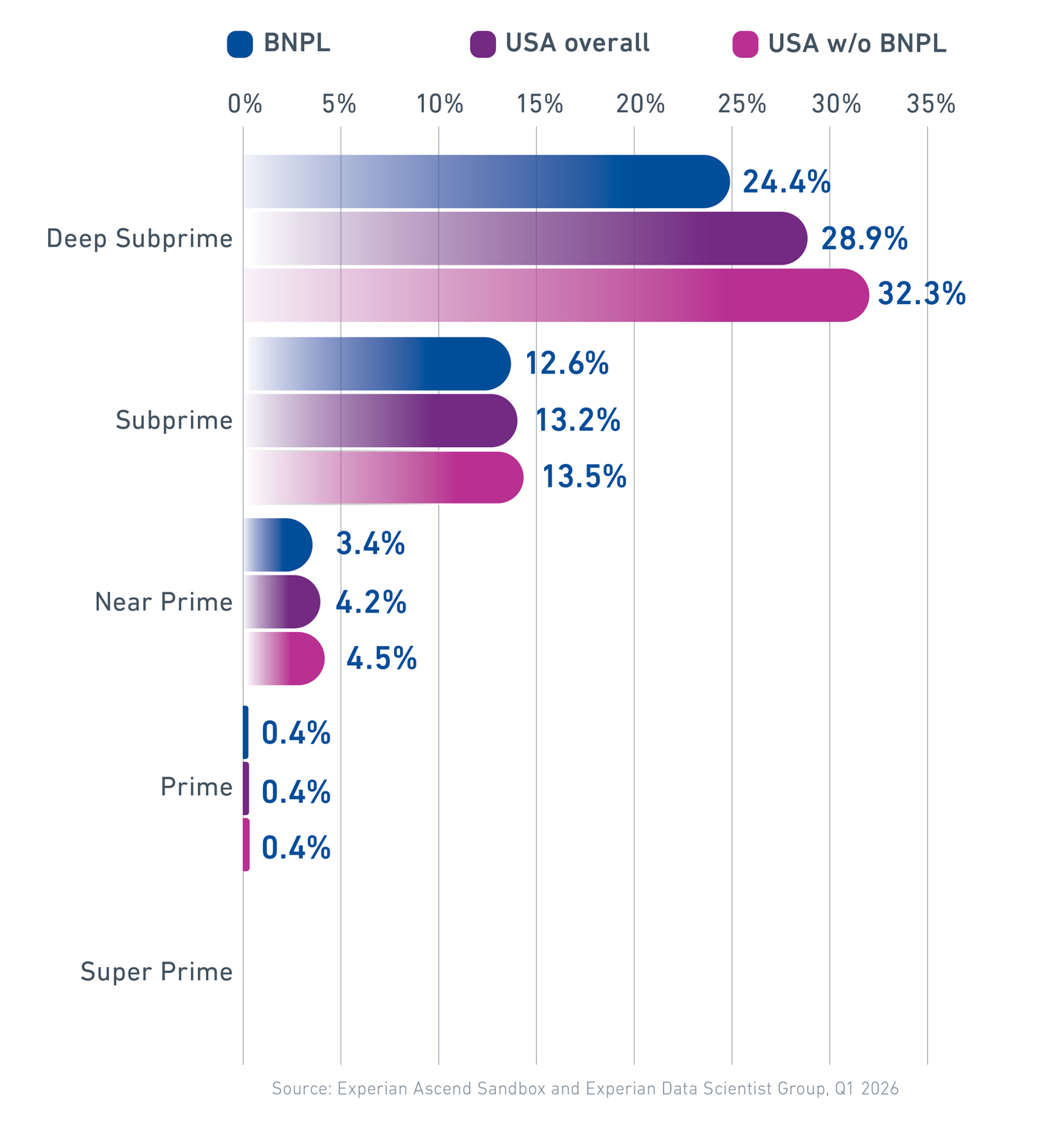
    • 63% of BNPL inquirers are near-prime or below, but within those segments, loan performance often exceeds peers.4
  3. Income divergence is the new risk layer

    • Higher-income consumers are showing strain through rising utilization.4
    • Lenders relying on score alone are extending credit into weakening segments and missing stronger borrowers whose financial position isn’t fully visible.
  4. AI is reshaping the discovery layer

    • 33% of consumers used generative AI in their holiday shopping journey, more than double in 2024.1
    • Being top of wallet in an AI-mediated shopping journey requires being top of data — the institution with the freshest signal on consumer capacity and behavior wins the offer.
BNPL 60-180 DPD rate vs. non-BNPL population by credit tier

Within near-prime and lower tiers, BNPL consumers actually outperform their non-BNPL peers — making BNPL inquiry a signal of credit intent, not just elevated risk.

3. The imperative

Win the wallet before the swipe

Two levers matter most: extending the right credit before October and activating the portfolio you already have. The income divergence data changes the segmentation logic — the consumers who look safe by score may not be, and the consumers who look risky may outperform. Both require more data signals, rather than tightening criteria or additional rules.

New consumers

Acquire with income-aware precision

Target consumers with multiple existing lines of credit and position competitive limits against them, using income-verification and cash-flow signals alongside bureau data. Experian analysis shows total consumer exposure often runs materially higher than traditional credit files suggest, particularly where BNPL and alternative lending sit off-bureau.

Existing consumers

Activate and recalibrate

Identify consumers showing positive credit migration and extend limit increases ahead of peak spend. The $44 billion Q4 balance increase confirms demand. Will your book capture its share?

What you can do now

Consider possible incremental revenue from proactive credit limit increases: Follow a simplified model for sizing the revenue opportunity from a proactive credit limit increase campaign ahead of the season.
4. The capability gap

The intervention window is narrowing

Experian Q1 2026 data reveals that 79% of accounts reaching 60+ DPD charge off within 6 months. Early delinquency at origination is at a 12-month high.6 The practical implication: By the time aggregate portfolio metrics show stress, the window to intervene without significant loss may have already closed. Intervention has to start before the season, not after the spend has already happened.

53%of businesses cite AI-generated phishing as their top AI-enabled fraud risk, ahead of first-party fraud, document forgery and deepfakes. Experian 2026 Fraud & Identity Report
~50%of consumers say they feel more like a target for fraud than they did a year ago. Experian 2026 Fraud & Identity Report

Strategy: Use alternative data to extend growth safely

  • Cash-flow and bank-transaction data close the underwriting gap for thin-file and credit-invisible applicants, including Gen Z entering independent credit eligibility now.11
  • Income-verification signals matter for every tier, not just subprime. Experian data shows higher-income utilization rising as a stress indicator, not just a usage signal.4
  • BNPL visibility: More than half of BNPL inquirers also hold alternative credit products not in traditional files. Total exposure is often materially higher than bureau data alone reveals.4

Strategy: Use data to stop fraud

  • Identity-matching at balance transfer or new account opening confirms the applicant is real, which is critical as AI deepfakes accelerate synthetic identity creation.8
  • Dormant-account monitoring flags bust-out patterns before they activate during the season’s highest-volume window.
  • Fraud sandboxes compress model deployment from months to days.


Tightening fraud controls during peak season can suppress approval rates of good customers who lack sufficient signals behind them. Better data can help tighten fraud defenses.

5. The path forward

Prioritize by wallet-share impact versus effort. Know your fallback if resourcing is tight.

Early warning and proactive risk identification should be prioritized alongside credit limit increase activation, not post-season.

InitiativeWallet-share / risk impact
Proactive CLI on positive-migration accounts — segmented by income tier, not just score High | This directly drives incremental spend capacity; income-aware segmentation reduces charge-off exposure on expanded limits.
Early-warning monitoring High | 79% of 60+ DPD accounts charge off within 6 months.
BNPL inquiry monitoring as acquisition signal Medium–High | High-intent consumers are identified before traditional credit activity surfaces them.
Alternative-data underwriting for thin-file/Gen Z applicants High | This opens a growing segment entering credit eligibility now.
Identity verification at balance transfer Medium | This reduces fraud loss and offers a modest direct growth upside.
AI-fraud/deepfake model rebuild High long-term | 53% of businesses flag AI-generated phishing as their top AI-enabled fraud risk.

Let’s talk strategy

The teams that move on this in the next 60 days will be positioned to win wallet share during the highest-spend window of the year. We’d welcome a working session to pressure-test this framework against your specific portfolio data.

Contact us to schedule a strategy conversation


Sources

  1. Adobe Analytics, “Holiday Shopping Season Drove a Record $257.8 Billion Online with Consumers Embracing Generative AI Tools,” January 7, 2026
  2. Deloitte, “2025 Holiday Retail Survey,” October 2025
  3. Federal Reserve Bank of New York, Center for Microeconomic Data, “Household Debt Balances Grow Modestly; Early Delinquencies Level Out for Non-Housing Debts,” Q4 2025 Quarterly Report on Household Debt and Credit, February 10, 2026
  4. Experian, "Insider Market Insights Q1 2026" — The Ripple Effect: Income Divergence; Early Stress Signals: Hidden Risk Amid Surface Stability; Spotlight: Understanding BNPL Consumers. Source data: Experian Sandbox and Experian Solution Insights Group; Experian Data Scientist Group
  5. National Retail Federation, “NRF Expects Holiday Sales to Surpass $1 Trillion for the First Time in 2025”; “NRF Forecasts 4.4% Annual Retail Sales Growth," 2026
  6. Deloitte, “Holiday Retail Forecast 2025,” September 2025
  7. Experian, “2025 Holiday Spending Trends and Insights
  8. Experian, “2025 Identity and Fraud Report
  9. Experian, “2026 Identity and Fraud Report
  10. Federal Trade Commission testimony on 2025 Consumer Sentinel reports: $15.9 billion in consumer-reported fraud losses in 2025, March 25, 2026.
  11. U.S. Census Bureau; Experian Economic Strategy Group, Gen Z credit-eligibility cohort analysis
  12. eMarketer, “BNPL is shining this holiday season,” December 2024
© 2026 Experian Information Solutions, Inc. All rights reserved.
Experian and the Experian marks used herein are service marks or registered trademarks of Experian Informations Solutions, Inc. Other product and company names mentioned herein are the property of their respective owners.